


Chapter 7 Bankruptcy Attorney in Fort Myers, Florida
Fort Myers & Florida Chapter 7 Guide
If you’re here, there’s a reason.
Maybe the bills are stacking up. Maybe a lawsuit just showed up. Maybe you’ve been “managing” for a while… until the math stopped working.
That’s what we see every day.
Our firm works with individuals and families across Southwest Florida — and throughout the state — who need a real plan, not more pressure.
Chapter 7 bankruptcy is not about failure. It’s about using federal law the way it was designed: to give people relief, protection, and a way forward when the numbers no longer make sense.
If you’re dealing with wage garnishment, a debt lawsuit, or foreclosure pressure, the situation can feel urgent, and that's because it is. The good news is that bankruptcy is one of the few legal tools that can immediately pause most collection activity through a federal protection called the automatic stay.
At Lynn Law Group, we guide clients through Chapter 7 and Chapter 13 with a focus on timing, strategy, and long-term stability. We are not just filing paperwork.
Fast answer: Can bankruptcy stop garnishment, foreclosure, and lawsuits?
In many cases, yes.
Filing a bankruptcy case typically triggers the automatic stay, which can pause most collection actions — including lawsuits, many garnishments, and foreclosure activity — depending on the specific facts of your case and any court orders involved.
Timing matters more than most people realize. The earlier you get advice, the more options you usually have, especially if:
- A lawsuit deadline is approaching
- A bank account has been frozen
- A foreclosure sale date has been scheduled
- Or a default judgment has already been entered
How debt collection usually escalates in Florida
Most creditors follow a predictable path:
- Collection calls and letters
- A lawsuit is filed
- A default judgment is entered if no response is made
- Garnishment or other enforcement actions begin
Florida law does provide certain protections in specific situation... including wage protections for individuals who qualify as “head of family.” But those protections are not automatic. They must be properly claimed, documented, and defended.
And this is where many people get caught off guard.
Someone may believe they are “judgment-proof” because their income is protected (for example, Social Security or certain wages) but that does not mean they are protected from stress, frozen accounts, or long-term legal exposure.
Judgments don’t simply disappear. They can remain in place for years, waiting for a change in circumstances.
Stopping wage garnishment in Florida
If your paycheck is being taken, the situation needs immediate attention.
A wage garnishment can affect housing, childcare, transportation, literally everything. Bankruptcy is often used to pause garnishments through the automatic stay, when appropriate.
Florida does offer strong protections for some individuals who qualify as head of family. Under certain conditions, disposable earnings may be exempt from garnishment, particularly when income falls below specific thresholds and proper procedures are followed.
But the key issue is not just whether protection exists, it’s whether it has been properly asserted.
A proper legal review should look at:
- Whether a judgment has already been entered
- Whether head-of-family protections may apply
- Whether bankruptcy (Chapter 7 or Chapter 13) is the right tool
- Whether timing can prevent further collection action
Bank account freezes and bank garnishments
Why accounts get frozen, even when funds may be protected
In Florida, once a creditor has a judgment, they can pursue a bank garnishment. This can result in your account being frozen while notices are issued and your right to claim exemptions is processed.
This is why people often feel blindsided.
Even when the money in the account may ultimately be protected, access to those funds can be disrupted in the meantime.
Bankruptcy is often used as a fast, structured legal response to stop this process and restore stability, depending on timing and case details.
Stopping debt lawsuits before they turn into judgments
The best time to act is before a default judgment is entered.
If you’ve been served with a debt lawsuit in Florida, ignoring it can lead to a default judgment, which gives the creditor significantly more power to collect.
A bankruptcy filing can often pause active litigation through the automatic stay, but the right approach depends on:
- The stage of the lawsuit
- Whether any legal defenses exist
- Whether Chapter 7 or Chapter 13 is the better strategy
Foreclosure pressure and time-sensitive decisions
If you are behind on mortgage payments, time matters.
Chapter 13 bankruptcy is often used to create a structured plan to catch up on missed payments over time, while maintaining bankruptcy protections during the case — subject to court approval and lender actions.
When a foreclosure sale date is approaching, options can become extremely limited very quickly.
In some cases, emergency bankruptcy filings may be used to stop a scheduled sale and create an opportunity to pursue a loan modification or structured repayment.
Early evaluation makes a significant difference in what is still possible.


Chapter 7 vs. Chapter 13 for Stopping Collection Actions
One of the most common questions we hear is:
“Which one actually stops what I’m dealing with?”
The answer depends on your situation, not just your income, but what kind of pressure you’re under.
Chapter 7
Chapter 7 is often used when the goal is to eliminate unsecured debt and reset financially.
For many people, this includes:
- Credit cards
- Medical bills
- Personal loans
- Certain judgments
Once a case is filed, the automatic stay typically goes into effect and can pause collection activity (including lawsuits and many garnishments) while the case is pending, depending on the specific facts.
Chapter 7 is generally the faster, cheaper, and most straight forward option. Most cases move from filing to discharge in a matter of 3-4 months.
However, qualification is required. This is determined through a financial analysis commonly referred to as the “means test,” which looks at income over a specific period of time along with other factors.
Chapter 13
Chapter 13 is often used when the situation involves assets, arrears, or ongoing obligations that need to be structured — not eliminated all at once.
It is commonly used to:
- Stop foreclosure pressure and create a plan to catch up on missed mortgage payments
- Stop repossession pressure and address vehicle or secured debt issues
- Create a single, court-approved monthly payment plan
- Catch up on arrearages over time while maintaining protection under bankruptcy law
Instead of eliminating everything immediately, Chapter 13 allows you to reorganize debt into a structured plan, typically lasting 3 to 5 years, while keeping certain assets and addressing past-due amounts in a controlled way.
The key difference (in plain terms)
Chapter 7 is often about wiping the slate clean.
Chapter 13 is often about creating a structured path forward when there’s something you need to protect or catch up on.
Both chapters can stop collection activity through the automatic stay, but the long-term strategy is different.
Which one is right for you?
That depends on several factors, including:
- Your income and whether you qualify for Chapter 7
- Whether you are behind on a mortgage or car loan
- Whether a lawsuit or garnishment is already in progress
- Whether you need to protect assets or catch up on arrears
This is where timing and strategy matter. The same financial situation can lead to very different outcomes depending on when and how action is taken
Do I Qualify for Chapter 7 Bankruptcy in Florida?
Do you qualify for Chapter 7 bankruptcy?
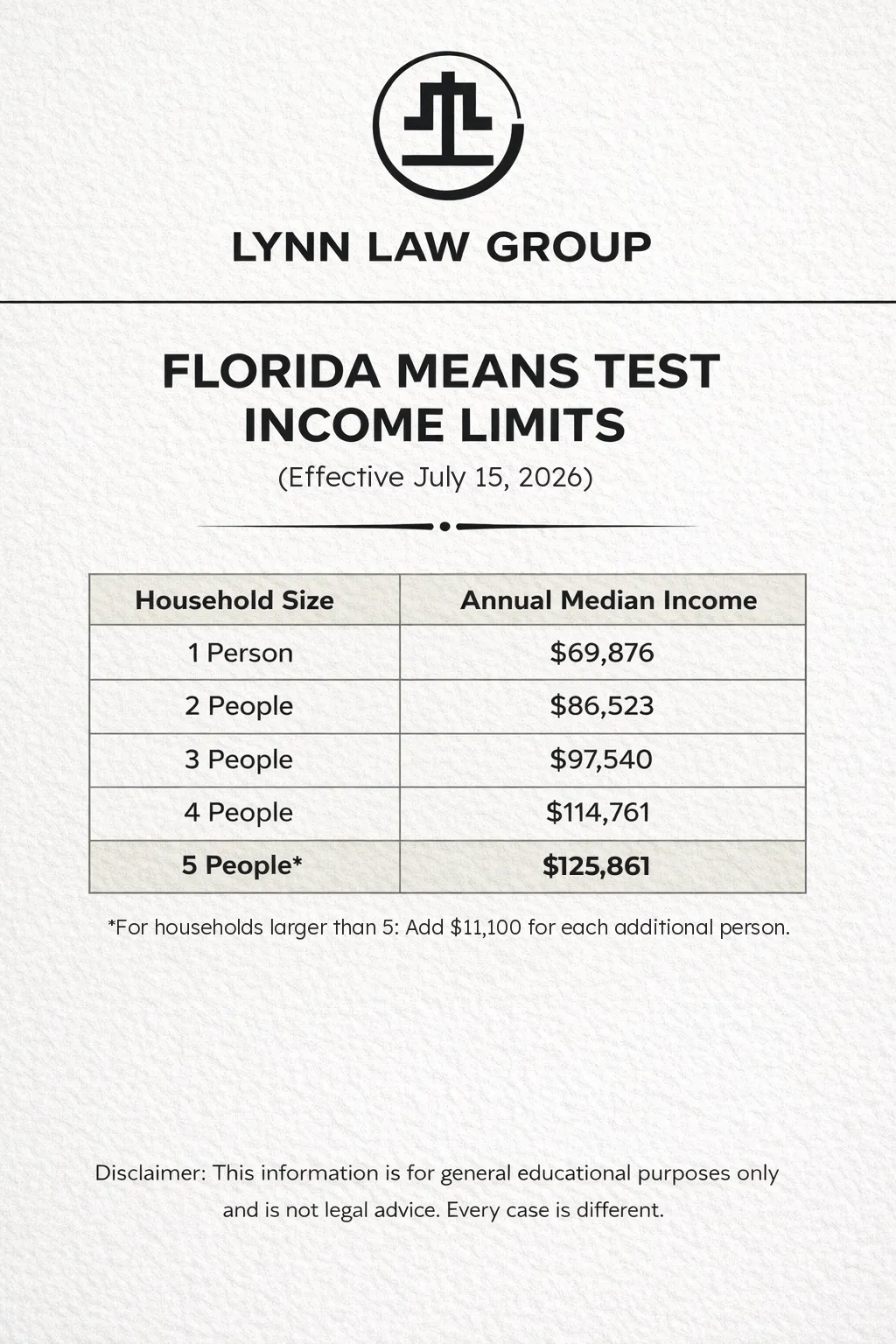
Qualification for Chapter 7 is based primarily on something called the means test - but in real life, it’s not as simple as most people think.
At a high level, the means test compares your household income over the last six months to the median income in Florida for your household size. These numbers are updated periodically, and the current limits (effective April 1, 2026) are reflected in the chart on this page.
But here’s the part most people don’t realize:
Being over the median does not automatically disqualify you.
You may still qualify for Chapter 7 if:
- Your household income is below the Florida median
- Your allowable expenses bring you within qualifying limits, even if your income is higher
- Special circumstances apply, such as:
- Loss or reduction of income
- Ongoing medical expenses
- Marital separation
- Recent job changes
- Certain non-filing spouse expenses
- Ongoing childcare expenses
This is where strategy matters. The means test is not just a number, it’s a detailed financial analysis.
At our firm, every consultation includes an attorney-led strategy session. We do not rely on generic online calculators or surface-level estimates. Small details can make a significant difference in the outcome.
Will you lose property in Chapter 7?
This is one of the biggest fears people have and in most cases, it doesn’t happen.
Most of our clients have kept all of their property in a Florida Chapter 7 case.
Florida has some of the strongest bankruptcy protections in the country, particularly when it comes to the homestead exemption and retirement accounts.
That said, every situation is different. Before filing, we walk through everything carefully so there are no surprises.
We review:
- Vehicles and loan status
- Home ownership and homestead eligibility
- Retirement accounts (such as 401(k)s and IRAs)
- Personal property and equity
- Cash on hand and bank account balances
- Business interests or side income
The goal is simple:
You should know exactly what is protected before your case is ever filed.
If any planning is needed, we address it upfront, not after the fact.
When creditors cross the line, we take action
Bankruptcy is not just paperwork. It’s a federal protection and it has to be respected.
Once a case is filed, creditors are required to stop most collection activity. After discharge, they are no longer allowed to attempt to collect on discharged debts.
When that doesn’t happen, we step in.
We regularly handle situations involving:
- Violations of the automatic stay (calls, letters, or collection attempts after filing)
- Violations of the discharge injunction (trying to collect after the case is over)
Because our practice also includes consumer protection laws like the FDCPA, FCCPA, and FCRA, we are able to go beyond simply notifying the creditor.
Depending on the situation, we may pursue:
- Motions for sanctions in bankruptcy court
- Adversary proceedings
- Federal consumer protection claims
In other words, if a creditor ignores the law, there can be consequences.
This is an important part of protecting your fresh start and it’s something many firms do not actively pursue.

Our Chapter 7 Bankruptcy Process: Clear, Streamlined, and Client-Friendly
Our Chapter 7 Bankruptcy Process: Clear, Streamlined, and Client-Friendly
1.
Free, confidential consultation
We begin with a private consultation by phone, Zoom, or in person at our Fort Myers office. You speak directly with one of us — never a staff member.
2. Customized analysis of your financial picture
We review your debts, assets, income, and overall goals. We explain the differences between Chapter 7 and Chapter 13, how Florida exemptions apply to you, and what options make the most sense for your situation. We take a holistic approach, because both short-term and long-term goals matter.
3. Document preparation with guidance at every step
We clearly explain what information is needed and walk you through the process so nothing feels overwhelming or confusing.
4. Filing and immediate protection
Once your case is filed, the automatic stay goes into effect immediately, stopping collection activity and providing relief.
5. The 341 Meeting
We prepare you well before your 341 meeting so you know exactly what to expect and can feel confident going in. These meetings are currently held by Zoom, and you can join from home or come to our office if you prefer. By the time your meeting happens, you will have already answered the same types of questions with us — we don’t believe in surprises. Being honest and upfront allows us to protect you and guide you smoothly through the process.
6. Discharge and your fresh start
After your discharge is entered, we discuss next steps — including rebuilding credit and protecting your financial future, if you choose.
Transparent Reasonable Fees and Clear Expectations
We encourage clients to review our Frequently Asked Questions, and while we do not publish pricing online (case complexity varies), our firm is built on transparency and predictability.
Our approach includes:
- Flat-fee pricing
- Flexible payment options
- Payment plans available before filing
- Clear, upfront expectations
- No surprises
**We are consumers ourselves, and we believe bankruptcy fees should be reasonable, predictable, and transparent. Our pricing is competitive, and our focus is always on providing real value and peace of mind.
Serving Southwest Florida — and All of Florida Remotely for Bankruptcy Cases
Serving Southwest Florida — and All of Florida Remotely for Bankruptcy Cases
Our physical office is located in Fort Myers, Florida, and we regularly represent clients throughout Southwest Florida, including:
Lee County: Fort Myers, Cape Coral, Lehigh Acres, Estero, Bonita Springs
Collier County: Naples, Marco Island, Golden Gate, Immokalee
Charlotte County: Port Charlotte, Punta Gorda
Hendry County: LaBelle, Clewiston
Bankruptcy cases for these areas are handled through the Fort Myers division of the bankruptcy court.
We also represent clients statewide through remote appointments, including (but not limited to):
Miami • Orlando • Tampa • Jacksonville • Fort Lauderdale • Tallahassee • Pensacola • West Palm Beach
Bankruptcy is governed by federal law, which means you do not need to live near our office to receive experienced, effective representation.
Bilingual Representation (English & Spanish)
We proudly serve clients in both English and Spanish and can conduct:
- Consultations
- Meetings
- Ongoing communications
- Document explanations
Hablamos español. Podemos atenderle por teléfono, por Zoom o en nuestra oficina, y explicarle todo el proceso claramente en su idioma.
What You Can Expect When Working With Us
We offer:
- Free, confidential consultations
- Evening and weekend availability
- Remote appointments anywhere in Florida
- Flexible payment options
- A judgment-free, supportive experience
Take the First Step
Call or text Lynn Law Group today to find out whether Chapter 7 bankruptcy can give you the fresh start you deserve.
We would be honored to be part of your fresh start.
